Skid steer chaincase drive chain and sprocket wear should be documented as a combined condition assessment. Record the chain identity, a defined multi-pitch measurement and the condition of the mating sprockets before seeking a replacement recommendation. An elongation percentage is useful evidence, but it becomes a service decision only when it is compared with the applicable machine and chain requirements.
The practical task is to make the findings traceable. A photograph of a loose chain does not record the measuring span, and a chain-size label does not describe the condition of the sprocket teeth. Bringing those details together gives the service provider or parts reviewer a clearer basis for the next check. This guide explains that evidence record for a wheeled skid-steer chaincase. It does not cover compact track loader undercarriage sprockets or provide a procedure for opening, adjusting or repairing a chaincase.
Machine identification defines the chaincase inspection
Begin the record with the full machine model and serial number or PIN, then identify the installed chaincase and component position. Keep a photograph of the surrounding assembly with the close-up photographs. The relationship between the chain, its sprockets and neighboring shafts matters to the identification review; an isolated part can remove that context.
Separate the assembly being investigated from the assembly being quoted. If the request also includes a drive motor or reduction unit, use the existing guide to drive-motor and final-drive quotation boundaries to define that scope. The chaincase wear record should remain focused on the chain and its mating components.
Access and handling must follow the applicable machine service instructions. The measurement principles below are not instructions to open a chaincase, turn a drivetrain or work around moving components. Where access or the measuring method is uncertain, have the responsible service provider establish the safe inspection procedure before collecting the measurements.
Drive chain wear requires a defined measurement span
Roller-chain wear elongation is often described as chain stretch. Tsubaki explains that this wear elongation comes from wear at the pins and bushes, rather than deformation of the link plates. The distinction matters because a visible sag and a measured change in pitch describe different observations. Record the actual measurement instead of using a photograph of sag as an elongation result.
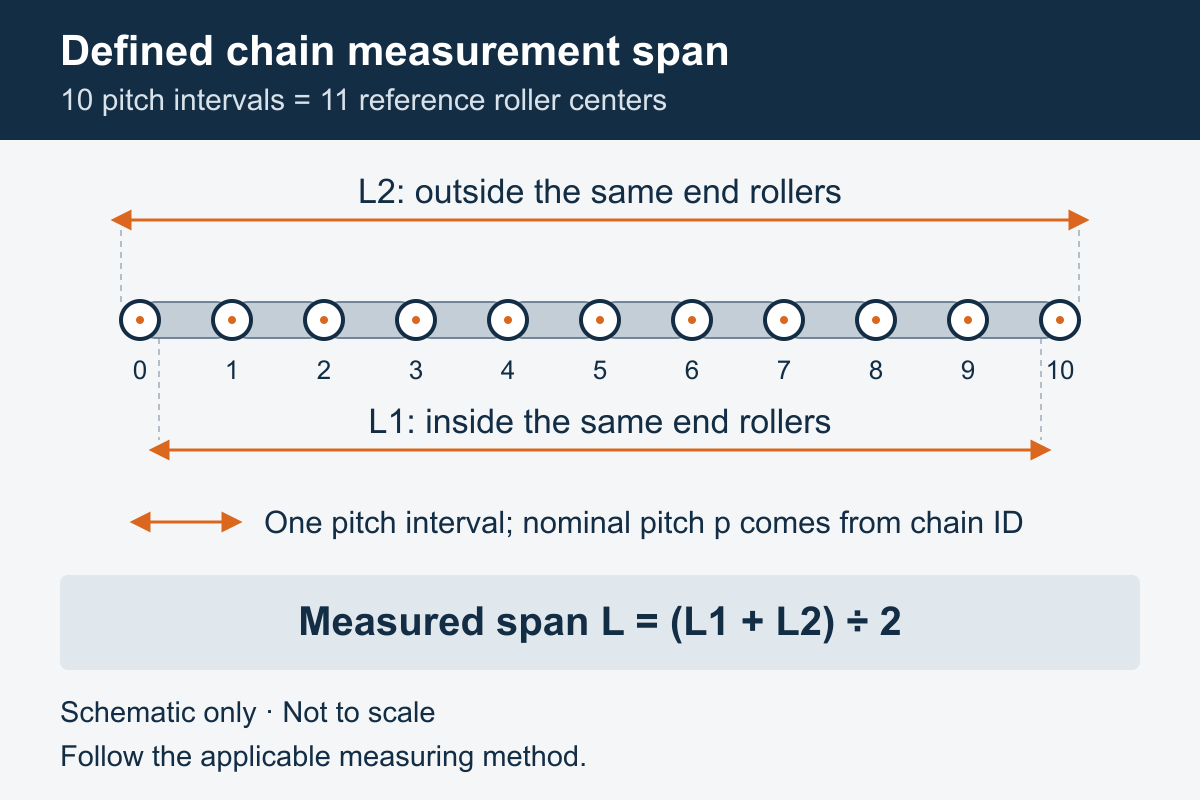
In its Installation and Maintenance Guide, Tsubaki measures a span across several links with slack removed. The method uses an inside reading, L1, and an outside reading, L2, across the same end rollers. Their average gives the measured span:
Measured span L = (L1 + L2) ÷ 2
The guide recommends measuring across 6 to 10 links to reduce measurement error. When documenting the span, make the count unambiguous: record the number of pitch intervals between the reference roller centers. A span of 10 pitch intervals has 11 reference roller centers from one end to the other. A photograph should show which endpoints were used, together with the units and the readings.
The nominal pitch must come from an identified chain specification or other verified identification record. It cannot be established merely by measuring a worn span and rounding to a familiar size. Record the chain markings and the source of the nominal pitch alongside the readings, so another reviewer can repeat the calculation using the same baseline.
For a known nominal pitch, the baseline and elongation calculation are:
Baseline length = nominal pitch × number of pitch intervals
Wear elongation (%) = (measured span − baseline length) ÷ baseline length × 100
Keep the raw readings. A final percentage without its pitch, interval count and measured length is difficult to check and can conceal a counting or unit error. The relevant measuring conditions, including how slack was removed, should also remain in the service record rather than being assumed by the next person who reads it.
A worked example separates elongation from the replacement limit
Consider a hypothetical chain with a verified nominal pitch of 25.4 mm. A span of 10 pitch intervals has a baseline length of 254.0 mm. If the measured span is 257.0 mm, the difference is 3.0 mm, and the calculated elongation is:
(257.0 − 254.0) ÷ 254.0 × 100 = 1.18%
These figures illustrate the calculation. They are not measurements from a customer machine, a recommendation for a particular chain size or a replacement threshold.
The next field in the record should be the applicable service criterion and its source. Tsubaki's general guide itself varies allowable elongation with sprocket tooth count and gives tooth-wear dimensions by chain size. That is a reason to preserve the application details, not to take one number from the table and apply it to every skid steer. The correct machine-specific criterion remains unverified until the relevant service information and installed configuration have been checked.
If that criterion is unavailable, record the result as a measured elongation with the acceptance limit still to be confirmed. A precise calculation can coexist with an unresolved replacement decision. Keeping those two facts separate makes the report more useful than an unsupported “within limit” or “replace now” conclusion.
Sprocket contact and wear complete the condition record
The chain measurement should be reviewed with the mating sprocket condition. Tsubaki states that a new roller chain running on a worn sprocket wears faster than normal. A replacement inquiry that documents only the chain can therefore omit a relevant part of the wear assessment.
Photograph the tooth contact faces and any visible uneven or side wear, while preserving the installed orientation in the record. Tsubaki identifies improper sprocket installation or a twisted chain as possible causes of lopsided contact and tooth-side wear. The word “possible” is essential: a photograph of side wear does not by itself establish which condition exists on the machine.
Use the photographs to define the next inspection question. A note such as “visible contact on one tooth side; alignment assessment not yet completed” separates the observation from the explanation. The reviewer can then determine which machine-specific checks are required, instead of inheriting a diagnosis that was never verified.
The same distinction applies to replacement scope. Evidence that a particular sprocket is worn supports reviewing that sprocket with the chain. It does not establish a universal rule that every adjacent sprocket, shaft or chain must be replaced as one kit. Document which components were inspected, which findings are available and which parts of the assembly remain unassessed.
A traceable inspection record supports the replacement review
A useful record keeps identification, measurement and interpretation together. The table below is an editorial framework for organizing those details; it is not an OEM inspection specification or an acceptance checklist.
| Record item | Evidence to retain | Question still requiring confirmation |
|---|---|---|
| Machine and installed position | Full model, serial or PIN, chaincase position and surrounding assembly photographs | Does the service information apply to this exact machine and configuration? |
| Chain identity | Readable markings, the nominal-pitch source and relevant identification dimensions | Has the chain specification been verified? |
| Measurement span | Reference endpoints, pitch-interval count, L1 and L2 where applicable, units and measuring conditions | Was the required measuring method followed? |
| Calculated result | Baseline length, measured span and the elongation calculation | What is the applicable service criterion and where is it documented? |
| Sprocket condition | Tooth-face and side views, installed orientation and recorded wear observations | Which contact, alignment or component-condition checks remain open? |
| Replacement inquiry | Components under review, available findings and explicitly missing information | What can be identified or quoted after the remaining checks? |
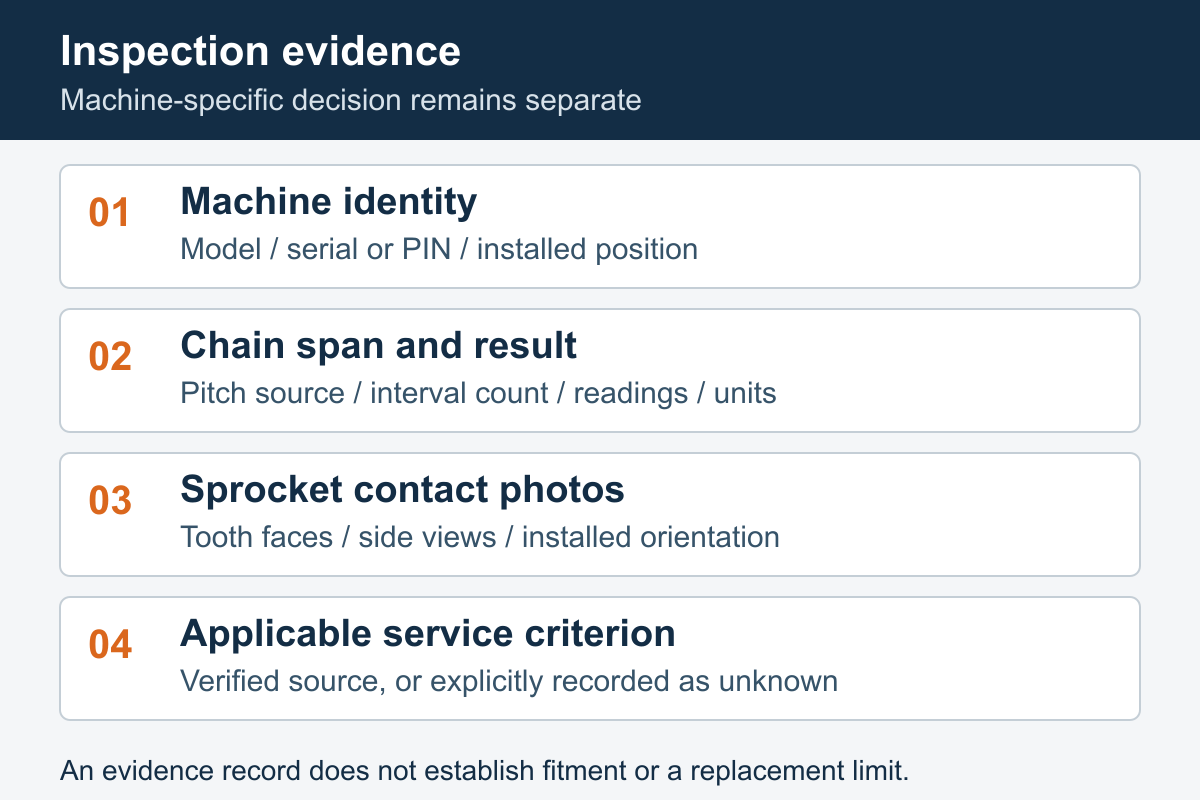
Write observations in terms that another person can inspect. “Measured span 257.0 mm across 10 pitch intervals” records a result; “chain is worn out” records a conclusion whose basis may be missing. Likewise, retain the original photographs and readings when producing a shorter inquiry summary. They allow the reviewer to distinguish an identification gap from a condition that has already been measured.
Chain and sprocket identification connects the findings to the inquiry
Once the condition record is organized, use the chain and sprocket identification review to connect it with the machine and part information. The site's review path asks for chain pitch, width, strand count and link count, together with relevant sprocket details such as tooth count, bore, keyway or spline, and hub offset. Provide those details from the installed component or its verified record, rather than guessing a match from appearance.
Include the measured span and calculation, the sprocket observations, and the service criterion if it has been established. State any missing measurements or unresolved inspection questions in the request. This allows the inquiry to distinguish the part-identification work from the service decision about what needs replacement.
A catalogue candidate is not confirmed fitment, and an inquiry does not establish stock, price or machine approval. The useful next step is a review of the actual machine identity, interfaces, installed configuration and condition evidence. That is the basis on which the remaining checks and a possible quotation can be defined.
Source and scope notes
The general roller-chain principles come from Tsubaki's Installation and Maintenance Guide, Catalogue M, with a 2015 cover date and a 2016 PDF file, principally printed pages 27–28 (PDF pages 26–27). They support the measuring method and conditional wear interpretation presented here. They do not supply an OEM-specific skid-steer acceptance limit, chaincase adjustment procedure, lubricant specification or replacement approval.